Skip to content


How Much Do Fitted Wardrobes Cost? A Joiner’s Honest Price Guide

How much do fitted wardrobes cost? For a straightforward melamine fitted wardrobe made by a bespoke joiner, you’re typically looking at around £1,800 to £2,400 per linear metre in 2026. A spray painted finish sits higher, at roughly £3,100 to £4,100 per linear metre. Those ranges are designed to allow for some drawers and lighting, so where your wardrobe lands within them depends largely on what goes inside.
Those figures come from our own pricing at Webb Bespoke Interiors, not a national average pulled from a survey. They’re also only a starting point. As Adrian Webb puts it, working out a job by the linear metre is “a poor way to calculate a job cost”, but it’s a reasonable rough guide. What really moves the final number is what goes inside the wardrobe, and that’s the part most cost guides gloss over. This one doesn’t.
Keep things simple, with mostly hanging space, and you’ll sit towards the lower end. Go heavy on drawers or lighting and it can take the job outside these brackets altogether.
What does “per linear metre” actually mean?
A linear metre is simply the width of the wardrobe, measured along the wall it’s built against. A wardrobe filling a 1.5 metre alcove is 1.5 linear metres. One running the full length of a 3.6 metre bedroom wall is 3.6 linear metres.
It’s a handy way to get a ballpark figure, because the carcass, doors and finish all scale with width. The trouble is that two wardrobes of exactly the same width can end up at very different prices. One might be mostly hanging rails and shelves. The other might be packed with drawers, pull-outs and lighting. Same width, very different amount of material and labour.
How much are fitted wardrobes? Prices by finish
The finish is the first big decision that sets your budget. Here’s how the two most common options compare.
Melamine fitted wardrobes
A straightforward melamine fitted wardrobe comes in at around £1,800 to £2,400 per linear metre. Melamine board has a decorative surface applied at the factory, so it arrives ready finished in a plain colour or woodgrain effect. There’s no painting stage, which is the main reason it’s the more affordable option. It’s hard-wearing, easy to wipe clean and a sensible choice for a lot of bedrooms, especially where the wardrobe interior is going to take a bit of a beating.
Spray painted fitted wardrobes
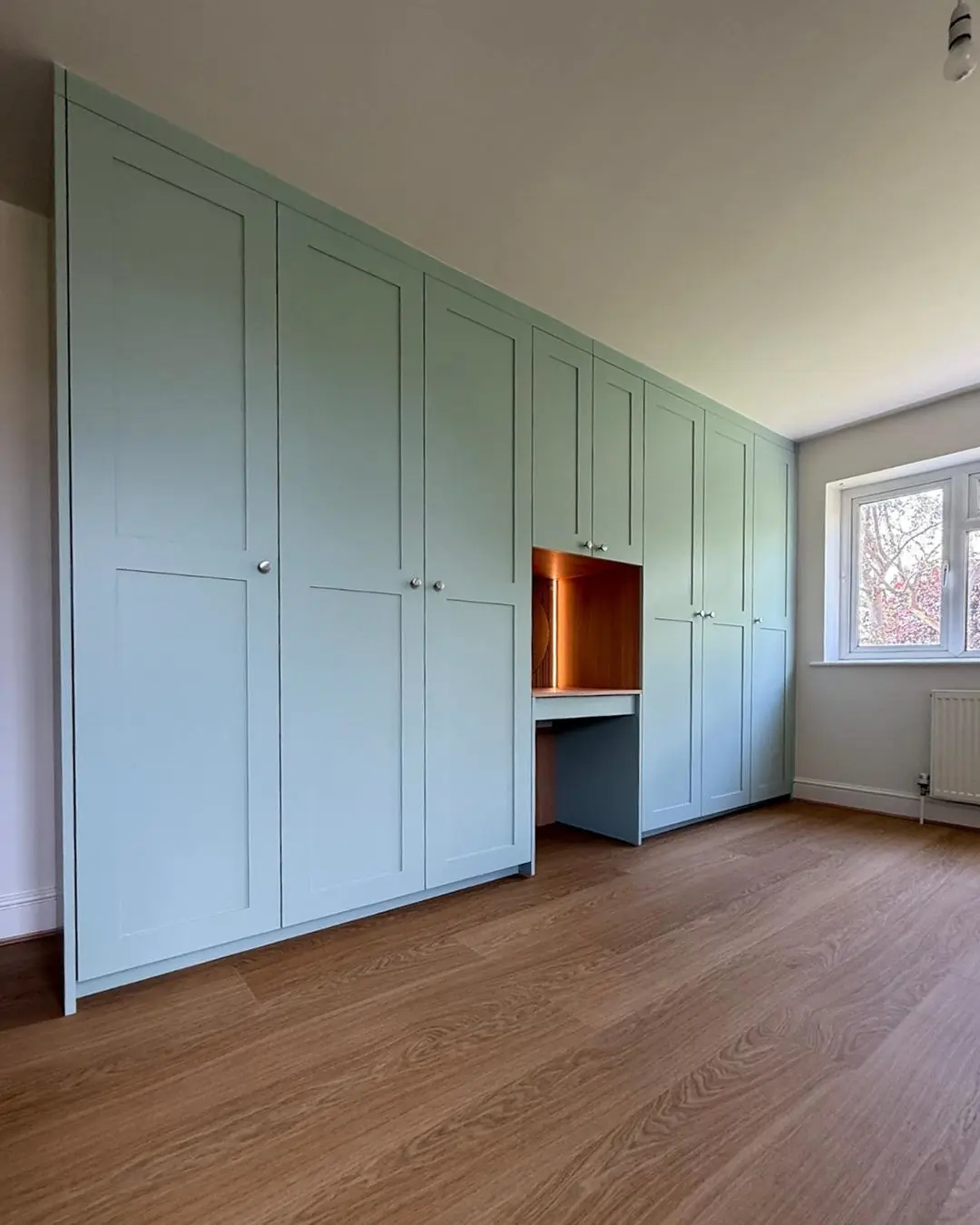
For a spray painted wardrobe, budget between £3,100 and £4,100 per linear metre as a guide. Everything that affects a melamine wardrobe still applies to a painted one. The difference is the finish, and a proper spray finish takes a lot of material and time. Each wardrobe gets two coats of primer followed by a top coat. To give you a sense of scale, two coats of primer on a medium sized set of wardrobes can use around 40 litres of primer on its own.
We price painted work based on the square metres of surface being painted and how complex the doors are. A flat slab door is quick to spray. A panelled or moulded door has far more edges and profiles to get right, which adds time. In return you get any colour you like and a finish that looks like furniture rather than flat pack. If you’re weighing up what sits underneath the paint, our guide to MDF vs solid wood furniture explains the difference.
How much does a fitted wardrobe cost once you add the internals?
Our per metre ranges already allow for a sensible amount of drawers and lighting. The gap between the bottom and top of each range is there to account for them to an extent. Where budgets really move is when a design goes much further than that. Lots of drawers, lots of lights or several specialised pull-outs can take a wardrobe outside the bracket, while simple hanging space keeps the cost down.
Drawers
Drawers are extremely material heavy. Every drawer needs its own runners, and we use premium runners from Blum. Blum says its runner systems are designed to be opened and closed 100,000 times, with load classes from 30 to 70kg depending on the system, which is why we don’t cut corners on them. Quality runners add cost, but they’re the part of a drawer you’ll notice every single day.
The bigger cost is often the board itself. Four large drawers can add another two to three full sheets of material to a project. Then there’s the drawer box. A melamine box is the most economical, while veneer, painted and solid wood boxes each step the price up. Dovetail joints or other complex joinery add more again, because they take far longer to make by hand.
If you’re watching the budget, be deliberate about where drawers go. A few drawers are covered within our guide prices, but a wardrobe full of them won’t be. Hanging rails and shelves are the most economical way to use the space, so it’s worth saving drawers for the things that really need them.
Specialist pull-outs and fittings
Specialised pull-outs, such as pull-out shoe storage, trouser rails or baskets, can considerably alter the cost. Each one brings its own hardware and usually needs the carcass built around it. For ideas on what’s possible, have a look at our custom wardrobe interior design ideas.
Lighting
Wardrobe lighting costs depend on how many lights you want and where they go. The activation method matters too. Lights can be triggered by door sensors, switched manually or controlled remotely, and each option is priced differently. If your lighting can run from an existing circuit, the electrical side is usually straightforward. If it needs a complete new circuit, the Planning Portal confirms that’s notifiable work under Building Regulations, so it’ll need to be carried out and certified properly.
The room itself
Sloped ceilings, chimney breasts, uneven walls and floors all take extra design and fitting time. The upside is that awkward rooms are where fitted furniture really proves its worth. Our post on whether fitted furniture can be designed for awkward spaces goes into this in more detail.
Fitted or bespoke: know what you’re comparing
If you’re comparing quotes, check you’re comparing like with like. Modular systems use standard sized units with filler panels to close the gaps, while genuinely bespoke furniture is designed and built for one room. The two are priced very differently. We’ve written about the real difference between fitted and bespoke wardrobes if you’re not sure which one you’re actually shopping for.
Other costs to budget for
A few costs can sit outside the wardrobe quote itself, so it’s worth asking about them up front:
- Removing old furniture. If there’s an existing wardrobe to strip out and dispose of, check whether that’s included.
- Decorating. Walls often need making good or repainting once old furniture comes out and the new wardrobe goes in.
- Electrical work. If you want lighting inside the wardrobe, find out whether any wiring work is needed and who’s doing it.
How long does it take?
According to MyBuilder, the whole process from first consultation to finished installation usually takes six to twelve weeks, with installation itself taking one to three days for a standard project. Most of that time is design and manufacture, which is exactly what makes a bespoke wardrobe fit properly.
How to get an accurate price for your fitted wardrobes
The only way to get a firm figure is to have the space measured and the design worked through with you. Our process runs in three stages. We start with a consultation to talk through what you need and put together initial ideas with a quotation. We then create digital designs for you to review before anything is made. Finally, we build your bespoke fitted furniture and install it ourselves.
Still deciding whether the investment makes sense? Our post asking are fitted wardrobes worth it? covers the long term value side, and our broader guide to bespoke kitchen and fitted furniture costs includes some real project examples. You can also browse finished work in our gallery.
We’re a family run, Which? Trusted Trader joinery business working across West Sussex, East Sussex and Hampshire. If you’d like a realistic price for your room, book a consultation and we’ll talk you through the options.